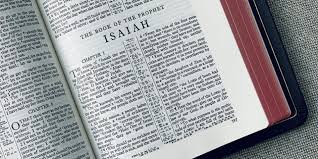
S – For to us a child is born, to us a son is given; and the government shall be upon his shoulder,
and his name shall be called Wonderful Counselor, Mighty God, Everlasting Father, Prince of Peace.
Isaiah 9:6 ESV
O – Commentary:
1. He was to be born a Child. The implication, given in parallel style, is that this Child, a Son, was to be born into the nation of Israel (to us) as one of the covenant people.
2. He will rule over God’s people (cf. Micah 5:2) and the world (Zech. 14:9). The government will be on His shoulders figuratively refers to the kingly robe to be worn by the Messiah. As King, He will be responsible to govern the nation. In Isaiah’s day Judah’s leaders were incompetent in governing the people. But the Messiah will govern properly.
3. He will have four descriptive names that will reveal His character. He will be the nation’s Wonderful (this could be trans. “exceptional” or “distinguished”) Counselor, and the people will gladly listen to Him as the authoritative One. In the kingdom many people will be anxious to hear the Messiah teach God’s ways (2:3). He is also the Mighty God (cf. 10:21). Some have suggested that this simply means “a godlike person” or hero. But Isaiah meant more than that, for he had already spoken of the Messiah doing what no other person had been able to do (e.g., 9:2–5). Isaiah understood that the Messiah was to be God in some sense of the term.
This Deliverer will also be called the Everlasting Father. Many people are puzzled by this title because the Messiah, God’s Son, is distinguished in the Trinity from God the Father. How can the Son be the Father? Several things must be noted in this regard. First, the Messiah, being the second Person of the Trinity, is in His essence, God. Therefore He has all the attributes of God including eternality. Since God is One (even though He exists in three Persons), the Messiah is God. Second, the title “Everlasting Father” is an idiom used to describe the Messiah’s relationship to time, not His relationship to the other Members of the Trinity. He is said to be everlasting, just as God (the Father) is called “the Ancient of Days” (Dan. 7:9). The Messiah will be a “fatherly” Ruler. Third, perhaps Isaiah had in mind the promise to David (2 Sam. 7:16) about the “foreverness” of the kingdom which God promised would come through David’s line. The Messiah, a Descendant of David, will fulfill this promise for which the nation had been waiting.
The Messiah is also called the Prince of Peace, the One who will bring in and maintain the time of millennial peace when the nation will be properly related to the Lord. Together, these four titles give a beautiful picture of the coming Messiah’s character (Isa. 9:6 includes the first of Isaiah’s 25 references to peace.)
John A. Martin, “Isaiah,” in The Bible Knowledge Commentary: An Exposition of the Scriptures, ed. J. F. Walvoord and R. B. Zuck, vol. 1 (Wheaton, IL: Victor Books, 1985), 1053.
A – As Christmas is approaching, it is astounding that 700 hundred years before, Isaiah is describing with such accuracy the Messiah. It is also amazing that it took that long for that prophecy to be fulfilled. The belief that the Messiah was coming had to wane as time went on but the word never died. We should endure in our trust and faith when God’s timing doesn’t move as timely as we desire.
R – Heavenly Father, you are the Christ and promised one. Thank you for sending our Savior to set us free from the bonds of sin. Empower us to grow our faith and trust even when the timing is challenging.
 Just Add Water . Chris Bonham